Rear Admiral Sir Morgan Charles Morgan-Giles
Royal Navy
Date of Birth: 19th of June 1914
Place of Birth: Shaldon, Devon
Date of Death: 4th of May 2013
Buried: Bristol, Gloucestershire


Mentioned in despatches multiple times, awarded the DSO, The George Medal, OBE and the 1939-45 Star, and the War Medal 1939-1945
Rear-Admiral Sir Morgan Charles Morgan-Giles, DSO, OBE, GM, DL was a Royal Navy officer, decorated during the Second World War, who later served as a Conservative Member of Parliament. At the time of his death, he was the oldest living former member of the House of Commons.
The eldest son of Francis Charles Morgan-Giles OBE, Naval architect and yacht designer, and Ivy Constance Morgan-Giles (née Carus-Wilson), Morgan's childhood was spent idyllically "messing around with boats" at Teignmouth, Devon, where his father had his boatyard.
 The river Teign By Derek Harper, CC BY-SA 2.0, https://commons.wikimedia.org/w/index.php?curid=12593418
The family lived across the river at Shaldon, Devon, necessitating a short row across the Teign River several times a day. Morgan said that he could "row before he could walk".
Morgan's first memory was of his father (on sick leave from the Royal Navy with petrol poisoning during the First World War) building a little dinghy for his young son. Due to the war, there was a shortage of good wood, and legend has it that FC Morgan Giles could not find quite what he wanted to finish her off.
His wife came home one day to find the best table in the house had mysteriously vanished but the little boat had a new mahogany transom. When the boat was completed (she was called Pip Emma and is now in the National Maritime Museum Cornwall in Falmouth) the three-year-old Morgan was placed in her and launched out to sea.
This started off his lifelong passion for boats and the sea. As a child Morgan's family would spend their Easter holidays at Swallerton Gate on Dartmoor. In 1928, when he was 14. he managed to save enough pocket money to buy a Douglas flat-twin motorbike for £2, which was also 14 years old.
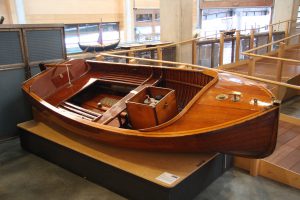 Shush was built to a very high standard by F C Morgan-Giles of Teignmouth in 1925 - National Maritime Museum CornwallIn addition to this form of transport, he was lent a little motorboat, one of the very first in-board motorboats, originally designed and built by his father, called Shush (also in the National Maritime Museum Cornwall) in which he spent nearly every waking hour, buzzing about on the river.
His father built a succession of sailing boats for Morgan, and his brothers and sister, to race, which they did with great success at regattas up and down the coast of Devon and Cornwall. Morgan was educated at Clifton College.
At Clifton, he demonstrated his ability to work the system as he wanted to crew for his father in a sailing race, but was told that instead, he must attend a cricket match between Clifton College and Tonbridge School.
So he took the train to London, passed through the turnstile at Lord's Cricket Ground; straight in, round and out again, and took the train down to Ryde, on the Isle of Wight, where father and son entered the race, and won; this was the Prince of Wales Cup, one of the most prestigious National dinghy races of the year.
Morgan joined the China Fleet as a midshipman at 18 in 1932, serving on a variety of ships, including Yangtze river patrol boats. He first sailed in the training cruiser HMS Frobisher to the West Indies and the Baltic.
He was then appointed to the Australian destroyer HMAS Voyager before serving in HMS Cumberland, Suffolk and Cornwall on the China Station before returning home to join the torpedo school at HMS Vernon. He was promoted to Torpedo Specialist in 1938.
During the Second World War
Morgan served on HMS Arethusa during the Norwegian Campaign in 1940, HMS Emerald escorting Atlantic convoys, and took part in the Battle of Oran.
 HMS Emerald © IWM FL 5381
In 1941, he was sent to the Suez Canal, where he was in charge of the anti-magnetic mine campaign. In April of that year, he acted as a liaison with the Royal Air Force using Wellington bombers as torpedo bombers.
During his time with No. 201 Group RAF at Dekheila, he survived three serious aeroplane crashes (one of which he was the sole survivor). Following a period of staff training at the Royal Naval College, Greenwich, Morgan-Giles was then sent to the Far East as Staff Officer Operations of Force W. There he accepted the Japanese surrender of Thailand.
Morgan was awarded the George Medal for "gallantry and undaunted devotion to duty" during bomb and mine disposal work while serving at HMS Nile, the naval base at Ras el-Tin Point, Alexandria.
Morgan had been sent to help clear the ships from the harbour as quickly as possible because they were loaded with explosive and ammunition, and (although unknown at the time) mustard gas.
Whilst onboard HMS Zetland, helping to get move the ship out of the harbour to minimise losses, a bomb struck a nearby ammunition ship, and he was thrown the length of the deck but was uninjured amongst the wreckage and fire.
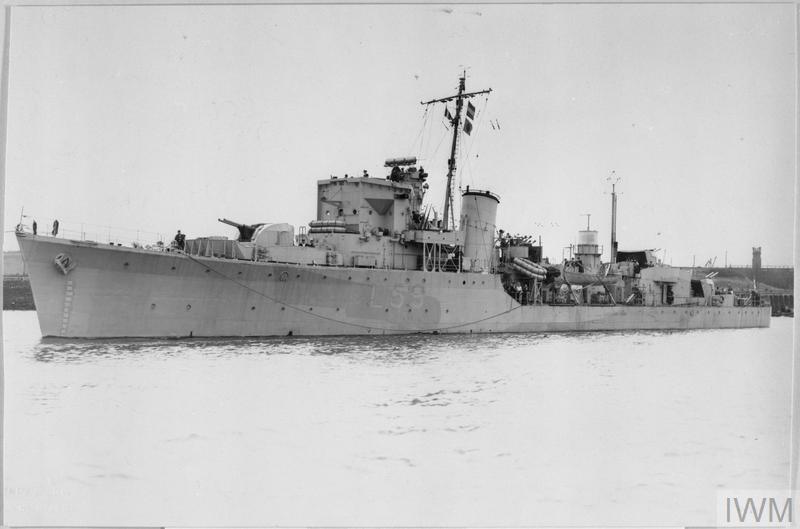 HMS Zetland © IWM FL 21954
He was nevertheless able to climb onto an American Liberty ship, SS Lyman Abbott that was blocking the harbour exit. Once aboard, he found not a single man alive, and no power, therefore no method of weighing her anchor.
He, and two other men that had joined him, were therefore forced to tamp explosive into the anchor chain, light the fuse and take cover. The explosion severed the cable, and they eventually managed to get the ship towed out of the way.
It emerged after the war that Lyman Abbott had also had mustard gas on board. Had Lyman Abbott been hit whilst still inside Bari's harbour, the casualties from the mustard gas would likely have been extensive.
Morgan later served with the Tobruk Garrison, in Tobruk during the Siege of Tobruk, where he 'swam' a mine out of the harbour, before being made the liaison officer in French destroyer Le Fantasque, and after that the Italian destroyer Legionario.
The siege of Tobruk - click the link to view the video
As an Acting Lieutenant Commander, he joined Sir Fitzroy Maclean's mission to Yugoslavia in October 1943, at his particular request. Initially, the Admiralty wanted to send him elsewhere, so Fitzroy had to appeal to the top..." you said I could have anyone I want for this mission", he asked Winston Churchill, "and I want Morgan Giles".
The prime minister agreed, over-ruled the Second Sea Lord, and Morgan joined Fitzroy in Cairo, Egypt, and was promoted to Acting Lieutenant-Commander.
Morgan became the Senior Naval Officer, based in Vis, in charge of running boats with guns and supplies across the Adriatic from Italy to the Dalmatian Islands in support of Tito's partisans. While aboard Wheatland, he commanded a Royal Navy force off the Kvarner Gulf Pag Island in Action of the 1st of November 1944 against the Kriegsmarine.
Morgan was Mentioned in Despatches once in 1942, twice in 1944, and once more in 1945. He received the George Medal in 1941, was appointed a Member of the Order of the British Empire in 1944 and advanced to an Officer of the Order of the British Empire in 1944, and was awarded a Distinguished Service Order in 1945.
Morgan was appointed a Knight Bachelor in the 1985 New Year Honours List for political services and was made Deputy Lieutenant of Hampshire in 1983. He also was awarded the Order of the Partisan Star (Yugoslavia) by Josip Broz Tito.

