Evacuate the children
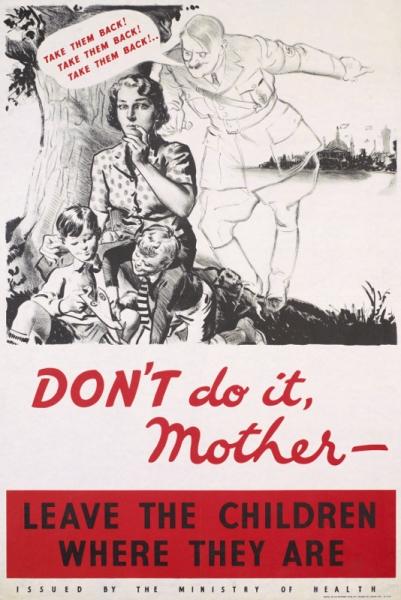 Evacuate the children © IWM (Art.IWM PST 8235)
In 1939 when this poster was made heavy bombing of the urban areas of Britain was predicted. When the first wave of evacuation began on 1st September 1.5 million children were moved, most in school groups.
However, as no bombing occurred during the first year known as the Phoney War nearly half of all evacuees returned home by January 1940. This poster was used to encourage mother’s to keep their children out of London as Hitler appears as a ghostly figure trying to get her to take her children back home.
Evacuees in Teignmouth and Shaldon
In 1938, anticipating the outbreak of war, the Ministry of Health sent out a survey to all local authorities to find out how much surplus accommodation was available in each area, after allowing one person to one room in each house. It also asked how many householders were willing to accept evacuees, particularly unaccompanied children or teachers.
The total surplus of rooms in Teignmouth was 8,597, meaning that the number of evacuees could be housed, including 1,121 unaccompanied children who could be taken in by householders voluntarily. There was some reluctance to accept evacuees.
In September 1939, the Teignmouth Post reported that 421 children from Acton Primary School in West London were evacuated here – 198 went to Dawlish and 223 came to Teignmouth. They were given tea at Brook Hill School (see below) and then went on to their new homes.
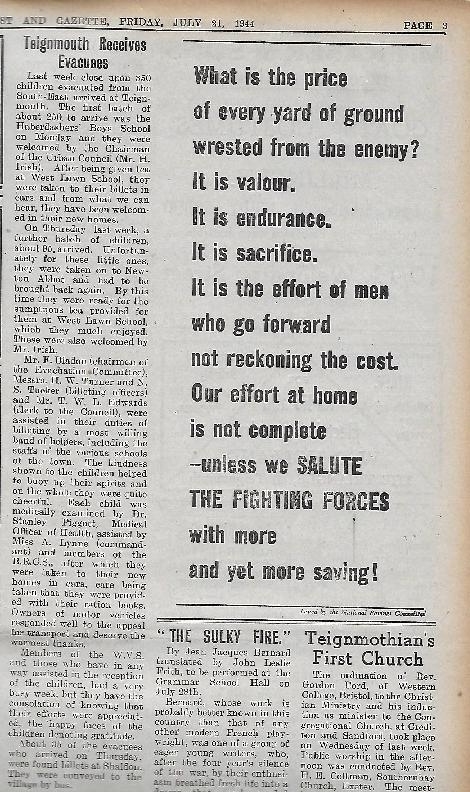 Teignmouth Post July 21st 1944
The children were chosen by local people on the basis of “those they thought would fit in with them”. One householder said:
“They were mainly dead-end kids in rags, dirty and ‘alive’. They had to be decontaminated at the Fever Hospital in Bitton Park”.
An evacuated child remembers:
“We three were amongst the last to be picked, and at the time I thought we must have looked the most unsavoury of all the evacuees and no-one wanted us. I had visions of being sent back to London or being put in an orphanage.”
Some evacuees were unofficial - children and adults staying with relatives and not attached to their school. Brook Street Infants had 261 evacuated children and their teachers, and at Our Lady and St Patrick School, there were 15 children and 1 teacher. Over 200 girls from Haberdashers Aske’s Girls School, with their teachers, arrived and were taught at Teignmouth Grammar School, where there was extra space. The other schools had to make use of church halls for the extra children.
After the end of the blitz in summer 1941, there was a steady drift back to London. The girls’ school remained until they left for North Devon in 1942 when Teignmouth was being bombed.
Later on, in 1944 when the V1 and V2 flying bombs (doodlebugs) were bombing London suburbs, the Council was informed on July 7th that 250 children and mothers were coming to Teignmouth and billets would have to be found for them. On July 11th 250 boys from Haberdashers Aske’s Boys School arrived in blazers and straw boaters, and 150 were unaccompanied, which meant that some billets had to be hurriedly rearranged. 60 boys were housed at 8 Powderham Terrace and the rest in individual homes. The following week 95 more children arrived who were found billets in Shaldon.
By September 1944 a report to Teignmouth Council said that the official numbers of evacuees were 1,294, of whom 501 were unaccompanied children, 229 mothers with 374 children, 130 other adults and teachers and 60 children in requisitioned homes.
For a few evacuees, it was an unpleasant experience. The unaccompanied primary children were young to be separated from their parents and brothers and sisters. Everyone had to carry a gas mask and have an air raid drill at school. But on the whole, the children were content. One evacuee later said:
“I cannot remember feeling at all strange living in Teignmouth…due to the fact that I was treated very kindly and made to feel like one of the family”.
* More information on Brook Hill School during WW2 is available via this link Brook Hill School

