
Lieutenant Avro Frederick John Hannaford
16 Bomb Disposal Company, Royal Engineers
Date of Birth: 9th of April 1917
Place of Birth: Teignmouth, Devon
Date of Death: 11th of November 2015


Awarded the 1939-45 Star, and the War Medal 1939-1945
Avro Frederick John Hannaford was born at Teignmouth, Devon, on the 9th of April 1917. He owed the choice of his first name to the fact that his father was in the Royal Flying Corps and flew the Avro biplane.
As a baby, being pushed in his pram along the Thames embankment, he was nearly killed when a bomb dropped by a German raider fell near Cleopatra’s Needle.
As a schoolboy, he won national prizes for architectural drawings and, from the ages of 14 to 18, trained in an architect’s office in Newton Abbot, Devon.
He then moved to London where he got a job with the Office of Works in Whitehall. One of his first tasks was to survey the seating at Westminster Abbey for the coronation of King George VI.
In the 1939 register, Hannaford was living at 1, Rutley Gardens, Lambeth, London. He was a Architectural Draughtsman H M Office Of Works.
After moving to Chorley, Lancashire, to help complete the Royal Ordnance Filling Factory, in early 1940 he was called up and joined the Royal Corps of Engineers. He was billeted in an abandoned stately home near Trafford Park, Manchester, with 300 former dockers from Liverpool.
A spell at Cardiff and Ross-on-Wye building roadblocks was followed by a move to New Brighton, Merseyside, where he was right under the flight path of German bombers targeting Liverpool docks during one of the heaviest raids of the war."
After six months of officer training at Aldershot, Hannaford was commissioned and posted to a holding battalion at Clitheroe, Lancashire.
From there one of his friends was posted to the West Indies as a water engineer, another to South Africa as a road engineer. When his posting came through, however, it was to Cardiff to join 16 Bomb Disposal Unit where his life expectancy was 10 weeks.
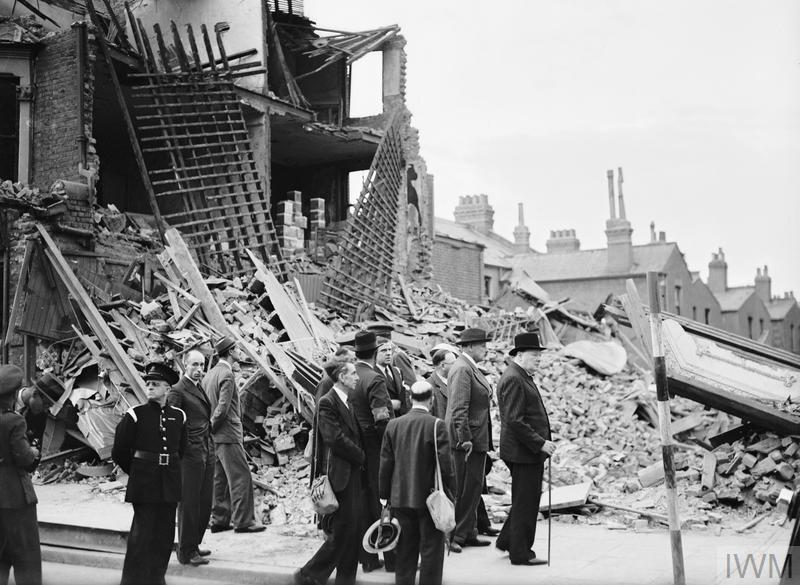 A German mine fell on a house in Shoreditch, East London on the 17th of October 1940 and failed to explode © IWM H 3978
At the end of the training course, he told his CO that he found this information very depressing. “Do you have anything good to tell us?” he asked. “As it happens, I have,” the CO replied. “The medical boffins have discovered that bombs explode faster than the human nervous system can react, so don’t worry, you won’t feel a thing.”
Hannaford was in command of a unit of 35 men. Based at Newport, Gwent, he was responsible for the clearance of bombs in an area of 100 square miles.
The responsibility was enormous but he could not discuss his anxieties with his men. It was very difficult, he said, for people to understand what it was like to be lying flat on your stomach in muddy water at the bottom of a 30ft shaft where the sides could cave in at any moment, running your fingers over a cold, sinister-looking, green-grey steel bomb that could send you to eternity.
 St Paul's Cathedral, rising above the bombed London skyline, is shrouded in smoke during the Blitz. © IWM (HU 36220A)
One of his worst experiences was when a senior officer was sent to instruct them in the working of a new stun grenade. Hannaford and his men had taken cover behind mounds of earth when the grenade was thrown. Instead of exploding, it just bounced.
Hannaford knew that the device should not be approached but when the instructor, who outranked him, said, “Let’s have a look at it,” he felt that he had to accompany him. He was appalled, however, to see the instructor pick up the grenade and then begin tapping it.
He had, he said, three choices. He could stay where he was and hope for the best, he could run for his life or he could try to distance himself. He had taken just two paces and turned away when there was a terrific bang as the grenade exploded, killing the instructor.
Hannaford was thrown to the ground with a piece blown out of the back of his head. He was patched up in hospital, but the images continued to haunt him.
In the 4th quarter of 1948, Hannaford married Joyce E Smith which was registered at Newton Abbot.
On the 11th of November 2015, Avro Frederick John Hannaford died at Brighton, Sussex.

