Preparations for war
In 1938, Brigadier Morrison, Teignmouth’s Honorary Air Raid Precaution Organiser ordered a supply of sledgehammers, picks, wheelbarrows, handsaws, hurricane lamps, ladders and other pieces of equipment for use in helping people to get out in a raid. But the equipment did not arrive quickly. Examples of these tools are on display in the Museum.
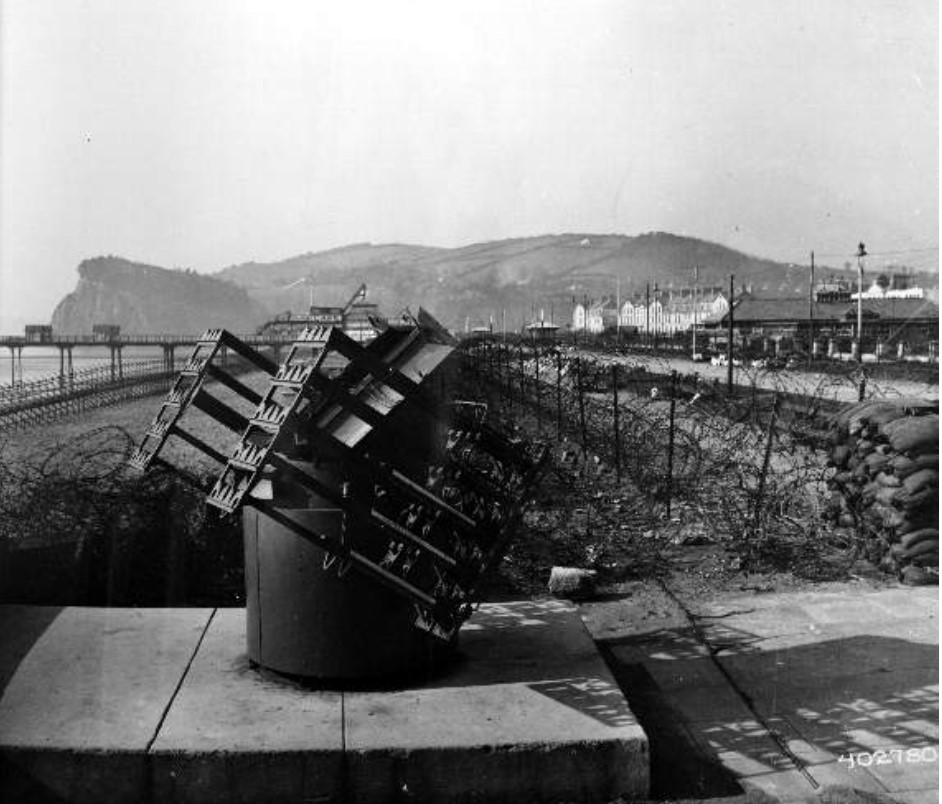 Rocket launcher on the Den, Teignmouth, Devon
ARP leaflets were sent out with rate demands encouraged 319 volunteers at the first appeal to sign up as Air Raid Wardens. Throughout the winter they travelled o Newton Abbot for 60 hours training in how to cope with anticipated poison gas attacks. Third class rail fare and 10/6 (53p) daily subsistence was allowed.
Teignmouth Urban District Council ordered trenches to be dug in open ground and sandbags to be requisitioned. A massive supply of bleach was ordered. The efficiency of an electric siren to warn people to take shelter was tested. The air raid siren from Bitton House, TUDC offices, is on display in the Museum.
The Ministry of Health ordered a survey of surplus accommodation and it was found that the town had sufficient space to cope with an estimated 8597 people. A civilian respirator was installed at Mill Lane Hospital and a Millbay Laundry van became a makeshift ambulance. Arrangements for dealing with death by war, transportation of bodies, mortuary and burials were discussed in council.
TUDC estimated the cost of preparing buildings for use as First Aid posts, refuges, decontamination centres and public shelters. But Devon County Council failed to respond to their estimates.
By 1940 barbed wire and scaffolding had been erected on the beaches at Teignmouth and Shaldon. Children were playing on the barriers but the first raid in July stopped all that.
Put that light out!
Teignmouth prepared itself for the Blackout as war was declared. All street lamps were switched off and effective coverings using black material were fixed to every window, lest the slightest beam of light became a target for an air raid. Tape was glued across windowpanes to restrict flying glass if the house was hit. Morrison shelters were set up instead of kitchen tables for protection and Anderson shelters were dug out in many people’s gardens.
As trainloads of Teignmouth and Shaldon men left home to serve in the Armed Forces, hundreds of children evacuated from London poured in by rail. But after the first surprise raid occurred in Teignmouth in July 1940, people began to leave Teignmouth for safer places if they could.
Food and petrol went on ration. Gas masks were issued to each person including children and even babies. Gas was the greatest fear at this stage of the war. In the museum on display is the “Mickey Mouse” gas mask for children and an overall gas mask for a baby.
 A Child's gas mask
Everyone had to carry an identity card. Posters advised the public to be alert to the possibility of spies. The messages were “Walls have ears” and “Careless talk costs lives”. In June 1940 the War office printed over 14 million copies of an advisory leaflet to the people of Great Britain.
“If the Invader comes – what to do and how to do it…you must not be taken by surprise”
1 If the Germans come, by parachute, aeroplane or ship, you must remain where you are.
2 Do not believe rumours and do not spread them. When you receive an order, make quite sure that it is a rue order and not a faked order. Most of you know your policemen and your ARP Wardens by sight…
3 Keep watch. If you see anything suspicious…go at once to the nearest police officer or station…
4 Do not give any German anything. Do not tell him anything. Hide your food and your bicycles. Hide your maps. If you have a car or motor bicycle, put it out of action when not in use…
5 Be ready to help the military in any way…
6 In factories and workshops, all managers and workmen should organise a system now by which a sudden attack can be resisted.
7 Think before you act. But think always of your country before you think of yourself.
With acknowledgement to Viv Wlson, Teignmouth at War 1939 to 1945, pub. 2000
Shaldon Village
In and around the village many defences and obstructions were built, including concrete block walls up to 7 feet high. One was built across the road between the Undercliff Hotel, now Ferryman’s Reach) and Dunns the bakers ( now The Strand cafe), thus blocking off Horse Lane.
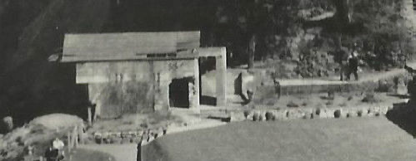 Gun site in front of Ness House, Shaldon, Devon
Another wall was between 25 and 26 The Strand (now the Clipper Café), blocking off access to the Quay. Others included one at Manor House Lane and another between Portview and Sandy Nook, blocking off Albion Street and Riverside.
Across the road, by the Ferry Shelter, a row of concrete and steel posts were constructed, which could be raised or lowered. When they were raised large steel angled posts were fixed to them to form anti-tank traps, known as “hair-pins”.
 Hair pins similar to those used in Shaldon, being inserted by Home Guard soldiers in York. Image: IWM (H 15191)
There were covered sand-bagged emplacements offering firing positions in front of the Undercliff Hotel and in the front gardens of Dunns, the Manor House and on the Quay.
The public Air Raid Shelter was a large brick building on The Green, built by local Edward Mole.
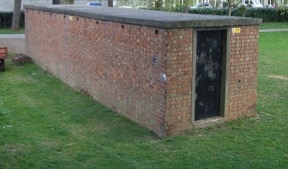 Air Raid Shelter (in Bristol) of a similar style to the one built on the village Green, Shaldon
Two large steel static water tanks were sited in the village, one in the wide space in front of The Green, the other in the road at the junction of Middle Street and Dagmar Street. Shaldon School was set up as an emergency centre.
Every householder could have a Morrison steel table air-raid shelter. It was delivered free but had to be assembled. Every house had to follow air raid precautions including blackout regulations, preventing light showing, and the taping of all the glass in their windows to prevent shattering.
As part of the war effort, metal had to be handed in, including iron gates and railings. All those in the village were cut down and collected, apart from the gates at Fonthill (then home of the Graeme family), which originated in India and were left because of their value. For safety reasons the railing around the school were also left, and those in front of the in The Strand called Laburnum.
German aircraft often flew over the village and up the river at a very low level, sometimes opening fire with machine guns shooting at anything and anybody, occasionally dropping bombs.
On 15th February 1941 over 1,000 incendiary bombs were dropped by an aircraft which had been hit and which eventually crashed near Totnes. The bombs dropped on a field near New Barn Farm, Ringmore.
 Shaldon, Devon WW2 Coastal Defence
On 13th August 1942, a bomb landed on The Green, its tail embedded there, but the war-head bounced, clearing the houses and landed in the allotments just below the Torquay Road.
In the summer of 1942, after the area had sustained unopposed bombing and many low flying aircraft, a large public meeting was called. The residents of Teignmouth and Shaldon petitioned Winston Churchill, and soon after the Royal Air Force Regiment moved in. They were the first anti-aircraft defences.
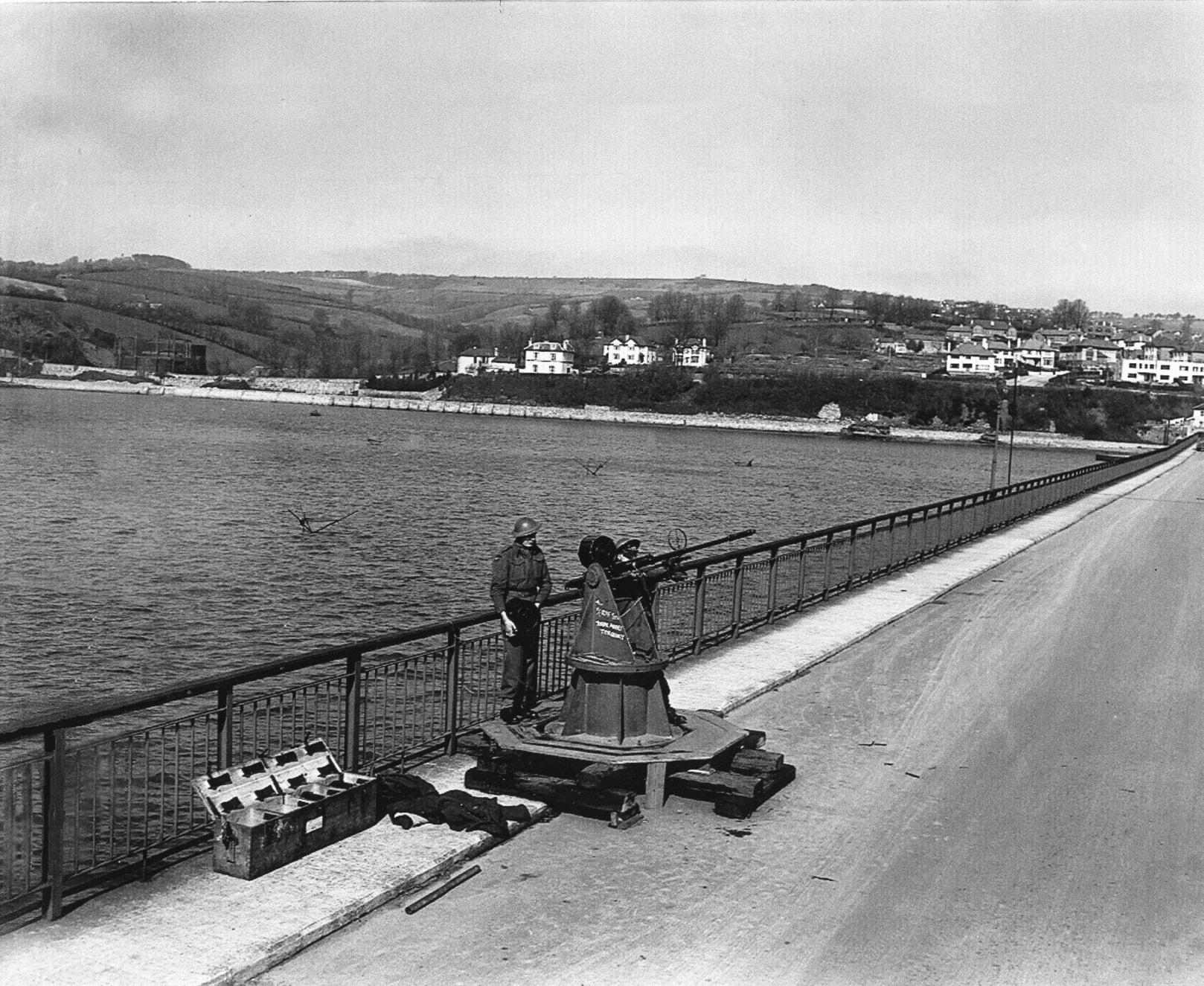 Gunner on Shaldon Bridge, Devon
They manned armoured cars, mounted with twin Bren guns, and were stationed at each end of Shaldon Bridge. The R.A.F Regiment stayed in the area until the Royal Artillery Light Anti-Aircraft Batteries moved in. They were equipped with Bofors guns which were positioned up at The Commons, on the Quay and on the Embankment. There were also Hispano anti-aircraft guns at each end of the bridge.
Despite these defences, on 18th May 1943, a high explosive bomb blew up the end of Teign House Hotel (now the end part of Dolphin Court) on Riverside.
 Teign House Hotel, Riverside, Shaldon, before was damage on the 18th of May 1943 at 2.45 am
Sea Search Light in Shaldon, Devon
The Building lower photo was one of Two buildings along Marine Parade which housed a Sea Search Light. Each Light had a light output of 210 Million candle power. These were 90cm Mk-V CASL (Modified Anti-Aircraft Searchlights). These were powered from the Engine House (now a Bat Conservation site in the sloping field opposite Ness House) which contained Two 22-Kilowatt Lister Diesel Engines.
 Sea Searchlight similar to the one used in Shaldon. (Public domain image)
 Sea Searchlight Housing, Marine Parade, Shaldon, Devon
Machine Guns
On the riverside of the road opposite the point, stood a 6pdr (57mm) HOTCHKISS Mk I or II QF on a pedestal mount with an extended platform, reportedly replaced later by a captured German Twin 2cm FLAK30/38 on Naval Pedestal mounting or just possibly Twin MG42 7.92mm Machine Guns. A French (M1897) 75mm Field Gun was also on hand as an auxiliary weapon.
- This wall was damaged in the storms last year and was removed, now replaced by metal railings. *
With acknowledgements to Tim Mole

