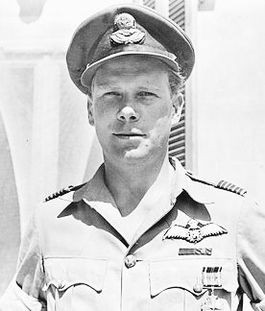
Wing Commander Billy Drake, DFC
Royal Air Force
Date of Birth: 20th of December 1917
Place of Birth: London
Date of Death: 28th of August 2011
Buried: Bishopsteignton, Devon
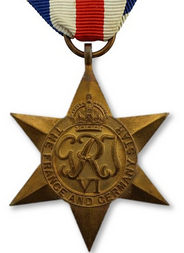

Awarded the DSO, the DFC, Air Crew Europe Star with France and Germany bar, 1939-1945 Star with Battle of Britain bar, Africa Star with North Africa 1942-43 bar, Italy Star, U.S.A. Distinguished Flying Cross, General Service Medal 1918-62 one bar, Malaya Coronation 1953, and the War Medal 1939-1945
Billy Drake was born in London on the 20th December 1917 to an English father and Australian mother. He was educated in Switzerland after several schools in England failed to cope with his lively temperament.
On seeing an advertisement in the Aeroplane he joined the Royal Air Force, just before his 18th birthday, on a short service commission in July 1936.
 Fury BiplaneHe was posted to 6 FTS, Netheravon on the 19th September and with training completed joined No 1 Squadron at Tangmere on the 22nd May 1937, flying the Fury biplane fighter. In late 1938 the Squadron received Hurricanes.
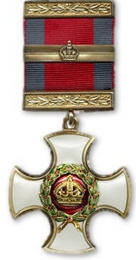 Distinguished Service Order (with bar)
He went to France with No.1 Squadron in September 1939 which was posted to Neuville-Sur-Ornain, near Reims.
From here over the next few months patrols were taken over the coastal ports as ships carrying the British Expeditionary Force to the continent sailed across the Channel. After initial skirmishes with the Luftwaffe,
Drake and his colleagues saw little action during the cold months of the "Phoney War". Given the lack of radar in France the only warning being condensation trails in the sky.
Thereafter squadrons were scrambled and action plans were developed en route.
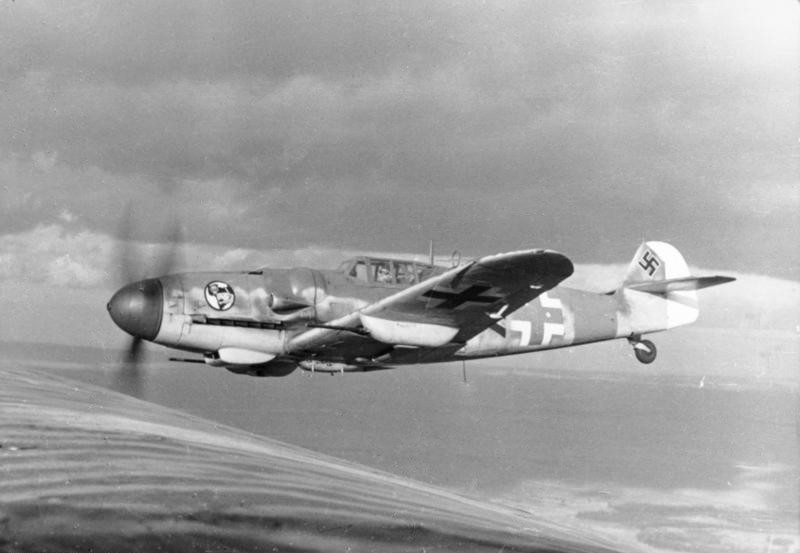 Messerschmitt BF109On the 20th April 1940 he destroyed a Messerschmitt Bf 109, on the 10th May a Heinkel 111 and on the 13th May he shot down a Dornier 17 and probably another but was jumped by some Bf 110s and shot down. He baled out of the aircraft and landed with back and leg injuries, he was taken to a French hospital and later flown back to an RAF hospital in England.
He spent much of the Battle of Britain training fighter pilots but after some arm twisting, he was allowed to join 213 Squadron who were based at Tangmere. On the 10th of October, he probably shot down a Bf 109 before heading to Gravesend to join a reconnaissance flight whose job was to fly over the English Channel looking for incoming German raiders.
 Distinguished Flying Cross
On the 7th of December, he shared a Dornier 17. He was awarded his first Distinguished Flying Cross in January 1941 and was posted to 53 OTU at Heston in February as a Flying Instructor. He went overseas in early October 1941 and was based at Freetown in Sierra Leone as a Squadron Leader to command No.128 Squadron whose role was to provide defence for the nearby naval facilities. Vichy French bombers occasionally strayed into the airspace, and on the 13th December, he intercepted one which refused his orders to land, with some regret he shot it down.
Life in Sierra Leone was too quiet for Drake, and his efforts to see more action paid off at the end of March 1942 when he left to join a Kittyhawk fighter bomber squadron in the Western Desert.
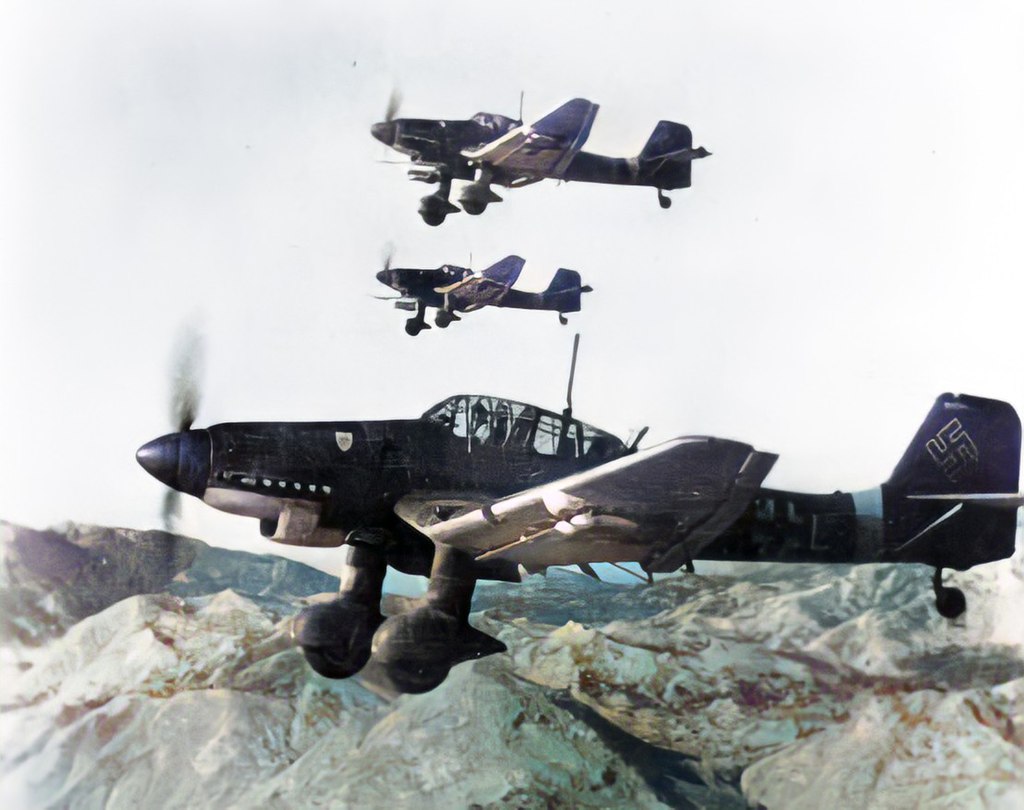 Junker 87 By Bundesarchiv, Bild 183-J16050 / CC-BY-SA, CC BY-SA 3.0 de, https://commons.wikimedia.org/w/index.php?curid=7177210Two months later he was given command of 112 Squadron at Gambut on the 24th pf May. He claimed a probable Bf 109 on June 6, another probable on July 2, destroyed Bf 109's on July 8th and 24th, destroyed two Junkers 87s on September 1st, a Bf 109 on the 13th, shared a Junker 87 and probably destroyed another on October 1st.
He downed a probable Bf 109 on October 22nd, destroyed another on the 26th, a Mac 202 on the 27th, a Junker 87 on the 31st, a Bf 109 on November 5th, a He 111 on the 15th, a Bf 110 and another damaged on the 19th, an Mc 202 and a Bf 109 on December 11 and finally a shared Bf 109 on the 13th.
In addition, he strafed 15 aircraft on enemy landing grounds. He was awarded a Bar to his Distinguished Flying Cross in July 1942 and awarded the Distinguished Service Order in December 1942.
Interestingly by October 1942, he had destroyed 17 aircraft in the air with two others shared, a total exceeded in North Africa only by one other pilot, the Australian born Group Captain Clive "Killer" Caldwell.
 Spitfire Supermarine
In January 1943 he was promoted to Wing Commander and posted to HQ RAF Cairo. He then took command of the Spitfire Wing in Malta in June 1943 and provided an escort to USAAF bombers attacking Sicily, before returning to the UK he was credited with another six enemy aircraft destroyed.
He received his American Distinguished Flying Cross in October 1943.
He was appointed Wing Leader 20 Wing flying Typhoons, in late November 1943, and attacked the German V-1 sites in the Pas-de-Calais. With his experience of fighter and ground tactics, he was sent to instruct at the RAF Fighter Leaders' School. Despite being in a training appointment, he frequently absconded for a day to take part in attacks against targets in France.
His operational career came to an end in August 1944 where he was sent to The USA on special duties. On his return to the UK, he was made Deputy Commander at Biggin Hill and later went to HQ SHAEF to serve in the Operations Room. He took part in the 1945 Battle of Britain flypast.
After the war, he served in operational headquarters, first in Japan and then Singapore. In 1949 he was posted to the Fighter Leaders' School as a senior instructor, an appointment much to his liking and where he converted to jets.
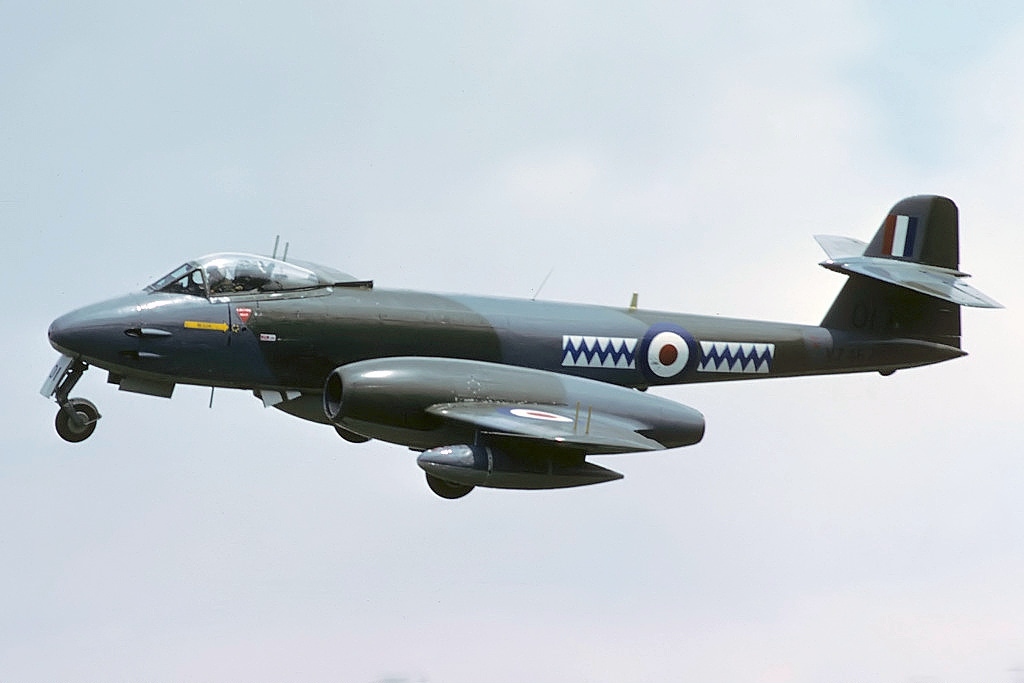 Meteor By Mike Freer - Touchdown-aviation - Gallery page http://www.airliners.net/photo/UK---Air/Gloster-Meteor-F8/2059465/LPhoto http://cdn-www.airliners.net/aviation-photos/photos/5/6/4/2059465.jpg, GFDL 1.2, https://commons.wikimedia.org/w/index.php?curid=26952764
This was followed by his appointment as Wing Commander at Linton-on-Ouse near York, where he commanded three Meteor fighter squadrons. In 1956 Drake became the Controller of Fighter Command's Eastern Sector.
He still found time to persuade colleagues to allow him to fly their fighters two or three times a month.
Two years later he left to be the Air attache in Switzerland spending the next three years in the country, a period he enjoyed greatly.
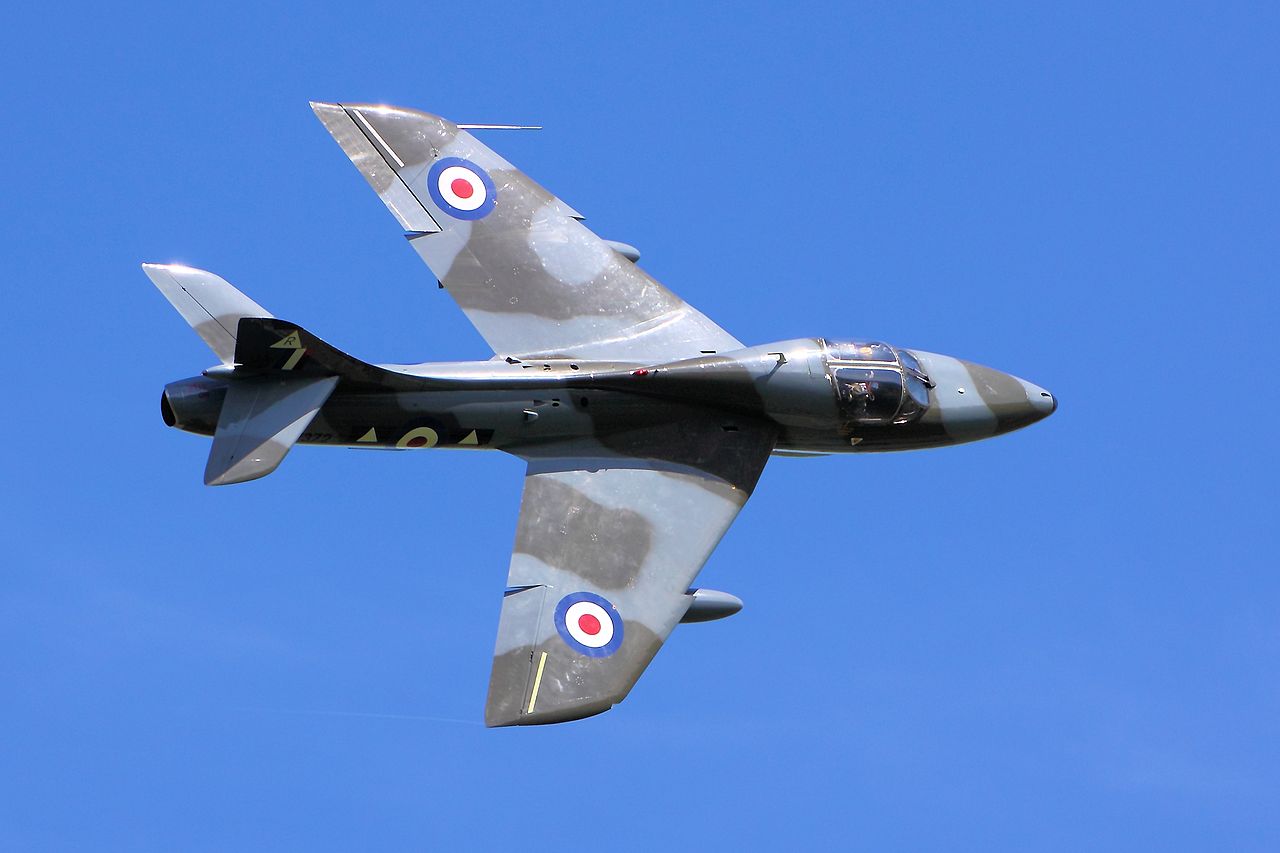 Hawker Hunter By Tim Felce (Airwolfhound) - Hunter - Shuttleworth Military Pageant June 2013, CC BY-SA 2.0, https://commons.wikimedia.org/w/index.php?curid=27813113
He returned to the UK in 1962 and took command of the RAF's fighter training base at Chivenor in Devon, where he flew the Hawker Hunter.
As a dedicated fighter pilot who had little interest in administration and staff work, he recognised that his flying days would soon be over. He, therefore, decided to retire from the Royal Air Force on the 1st July 1963, retaining the rank of Group Captain.
He spent 20 years of his retirement in the Algarve, Portugal, where he managed properties and ran Billy's Bar. In 1993 he returned to live in Teignmouth, Devon. His other great passion was skiing where he captained the RAF ski team and made annual trips to Switzerland, skiing into his early nineties.
He was known for wearing a cravat in the colours of English Epsom Derby winner Hyperion, later recalled, "By God, we had a good time. That's not to say we behaved the way Hollywood likes to portray Battle of Britain pilots. Of course, there were a few randy ruffians who would chase any girl. But generally, we all had girlfriends, and we didn't use the war as an excuse to sleep with them. We were gentlemen".
Billy Drake died at Bishopsteignton, Devon on the 28th August 2011, aged 93.
Billy Drake, who was born in London on the 20th of December 1917. Married twice (both dissolved, two sons), died Bishopsteignton, Devon on the 28th of August 2011.
As I noted in the Guest Book, Group Captain Billy Drake, formerly OC 112 squadron, lives here with me in the Officers' Association Country Home at Bishopsteignton in Devon.
Doug Tidy
Sqn Ldr RAF (Ret)
Ex 74 Squadron

