The Yankee Invasion
Early in 1944, a company of about 120 men from the US Navy 28th Construction Battalion set up their Headquarters in Teignmouth, to prepare for the D-Day landings. The “Seabees”, as they were known, had been in Iceland where they built a large airfield for planes covering the shipping convoys across the North Atlantic.
Their main depot was in Exeter, on the Topsham Road, and they took over part of Morgan Giles yard near the Point in order to service their landing craft. Later they assembled huge crates on the Promenade piled 10 feet high, which were to become a floating road between ships and Utah beach in Normandy.
They were billeted in the Courtenay Hotel, Overcliff and other seafront hotels and their canteen or mess was the Den Pavilion (later called the Carlton Theatre). In front of the buildings on Courtenay Place, Quonset huts for their supplies were erected, larger than Nissen huts. Mount Everest, a large house on Exeter Road, was used as their hospital.
The Americans were warmly welcomed. Children loved asking them for sweets and gum and got their first taste of ice-cream and banana. They mended a large hole on the walkway of the pier and then dances were held in the ballroom at the end.
They organised football and baseball matches on the Den and there was competition between them and Teignmouth. On one occasion the Teignmouth team won at baseball!
More than 2,000 men of the 13th and 28th regiments, including the US Army Coast Artillery Detachment, were billeted in Teignmouth, Shaldon and Newton Abbot. Some of them took part in the D-Day attack, at Utah and Omaha beaches in Normandy. The men left Teignmouth between 6th June and 20th July, and are fondly remembered.
BRUNO’S STORY, from Viv Wilson M.B.E.
Bruno A. Pettruccione of the “Seabees” (28th Construction Battalion US Navy), a former Master-at-Arms and Seabees Reunion Chairman, has fond memories of Teignmouth in 1944.
“I was in Teignmouth from May to August 1944. We were a good unit and at the risk of being immodest, good at what we had to do. Among the places we served were Scotland, France, Iceland and Okinawa. I was one of the younger ones. We enjoyed Teignmouth and before leaving for France, I spent part of every day in the Den Pavilion that served as our mess hall. As the Master-at-Arms (Internal Policeman) in the galley, I ran the work crews.
I bunked in the Courtenay Hotel across the street from the British Legion HQ on Den Crescent, where I spent a couple of hours of D Day.
I recall having some dances on the pier, the walkway to which had a large hole. We made temporary repairs to it. We also spent some time in the bar of the London Hotel and King William IV.
We had ice cream machines and the Chief thought it would be nice to treat the children…that worked well for the first Sunday. The crowd grew with each succeeding Sunday with the addition of older children and parents. One Sunday when we had no ice cream powder, in true Seabee ingenuity and negotiation, we served strawberry shortcake. Those strawberries cost us a lot of cigarettes.
The first Sunday after we arrived, I wandered about the town in my dress blues and a gentleman invited me into his house for afternoon tea and some cookies. At the time I hated tea but he and his family were gracious in sharing what I am sure was made from rationed items. Unfortunately, I could never find that house again.
A young lad who hung around the galley and ran errands sometimes sang, “There’ll always be an England” and we would add….” as long as there’s USA!” He was a good kid and if he’s still around, he can credit his longevity to me feeding him properly in 1944! We played football and softball on the Den, sometimes against some townspeople. One softball game was to benefit the local hospital, and to our chagrin, we lost.
I have a wooden plaque bearing the logo of the 28th…It should hang somewhere and we would be pleased if Teignmouth would do us that honour. I had then and still have a lot of respect for the British people’s courage, determination and resourcefulness in what were grim years.” The wooden Seabees plaque, which hung in the Carlton Theatre, is now on display in the Museum in the Shore Gallery.
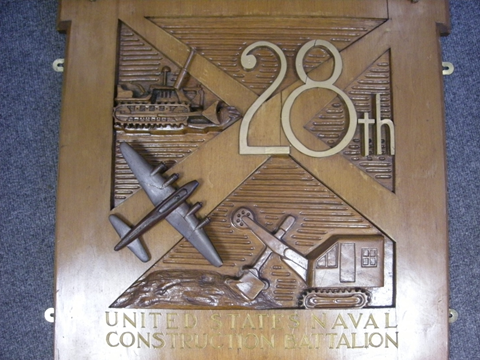 The wooden Seabees plaque

