AUXILIARY UNITS
The name was given to the “British Resistance”, the Auxiliary Units were hurriedly formed by Colonel Colin McVean Gubbins in June 1940. After the fall of France, it was assumed that Hitler would invade an almost defenceless Britain, trained soldiers were at a premium so Gubbins secret army was recruited from the civilian population.
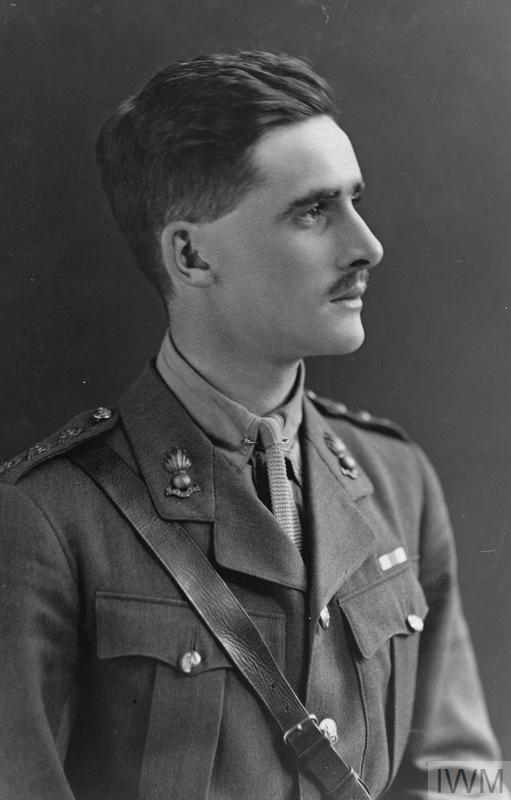 Captain Colin McVean Gubbins © IWM HU 115531
These men were grouped into three battalions to cover the east and south coasts; they were numbered 201 to cover Scotland, 202 north of the River Thames and 203 south of the Thames. All of the personal were not members of the normal Home Guard units.
They formed six- or seven-man teams which if the Germans had invaded would have gone underground, they built Operational Base’s, supply stores and arms dumps up to twenty feet below ground. The Auxiliary Units around 3,500 men were trained on weekend courses at Coleshill House near Highworth, Wiltshire, in the arts of guerrilla warfare including assassination, unarmed combat, demolition and sabotage.
Members were among the first troops to be issued with Tommy Guns, Plastic Explosive, Cyanide Pills and Sticky-bombs. Most of the men recruited were tradesmen or men who knew the countryside, originally the men were not issued with a uniform, but as the war progressed they were issued with Home Guard uniform.
The Auxiliary Units were officially stood down on the 19th of November 1944, for many years their existence remained secret, in 2000 I was finally successful in obtaining the service record of Cecil Hatherly. It shows that he joined the Civil Defence Service in May 1940, on the 6th July 1940 he was officially enlisted into the 9th Devon (Newton Abbot) Battalion Home Guard, it would have been at this time that he would have been recruited into the Unit.
On the 30th October 1942, he was transferred on official records to 203 Auxiliary Battalion, by this time the threat of invasion was past and I would guess this is when they would have been issued uniform. One of Cecil Hatherly’s role should there have been an invasion was to blow up Shaldon Bridge.
He was discharged on the 31st December 1944 on the disbandment of the Home Guard. On the 7th of April 2000, Private C.E. Hatherly, Home Guard, was posthumously awarded the Defence Medal.
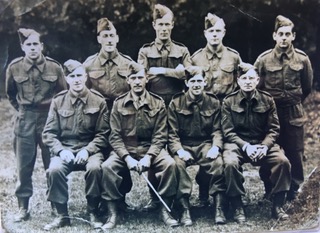
This photograph was taken in late 1944 in or around Ashcombe Woods at the stand-down of all Home Guard units and shows the original ‘core’ of the unit. All are wearing the standard Home Guard uniform, battledress with a brown leather belt, the men standing at rear apart from the officer are carrying rifles over their shoulder, Cecil Hatherly and Tom Weeks sitting have 9mm Sten Mk111 submachine guns.
All the men have lanyards connected to a sidearm (pistol in a leather holster). On the lower right arm of Cecil Hatherly, he is wearing Four years long service stripes.
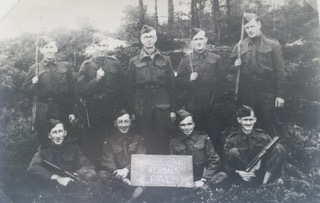 Auxiliary Units
Photo of nine men, board reads ‘The Original Kernals Pals’.
Standing left to right. Ernie Gover, Cecil Gilpin (Sgt), A.W. Eardley (Lt), Arthur Carpenter (Cpl), and Albert Trapnell.
Sitting left to right. Cecil Hatherly, Bill Leaman, Reggie Penhaligon, and Tom Weeks.
No1 (Teignmouth) Platoon, C Company 1941
Taken at Starcross Range
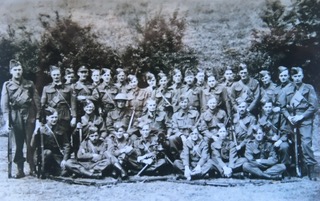 No1 Teignmouth Platoon, C Company, 1941
Rear Left to Right: L Bulley (Cpl), A Wadland (Cpl), Unknown, E Phillips, Seldon (Cpl), Rice, Wilfred Hill, C Willoughby, W Cardy, F Bennett (Cpl), A Satchell, Captain C Calmady, Hamlyn, 3 x Unknown, B Smith, W Haywood, G Lamble, and P Mann(Cpl).
Centre-Left to Right: Holmes. A Bolsworth, G Broben (Sgt), Lt E Houching, 2nd Lt R Walter, G Dixon (Sgt), A Harris (Cpl), and King.
Front Left to Right: E Rice, David Day, F Steven,. L French, R Renfree, and L Steer.
Officers C Company 1944
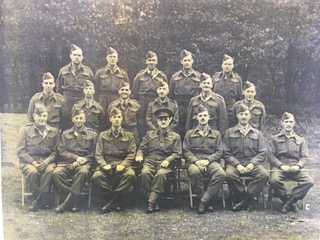
Rear Left to Right: Lt Peter Knibbs (NESS), Lt AW Eardley (AUXILIARY UNIT), Lt Bill Williams, Lt Don Sharpe (MOBILE PLATOON), and Lt Mark Andrews (ELECTRIC LIGHT COMPANY).
Centre-Left to Right: Unknown, Lt Walter Walkey, Lt Jack Gaskin, Unknown, Lt Tom Wotton (SHALDON), and Lt Archie Palmer (ELECTRIC LIGHT COMPANY).
Front Left to Right: Capt H Holoway (NESS), Lt R Walter (TEIGNMOUTH), Lt AR Drake (NESS), Major HG Bigg-Wither DSO (O.C.), Lt Allanson-Bailey (STOKE), Lt AW Woodgates (SHALDON), and Lt Bob Broom (MORGAN GILES).
Part of Morgan Giles Platoon Starcross Range 1943
 Part of Morgan Giles Platoon, Starcross Range 1943
Rear Left to Right: Tim Seymour, Tapp, Brian Bugler (Cpl), Ted Rice, and Tom Hunkin.
Front Left to Right: Eric Phillips (Sgt), Lt Bob Broom, Fred Matthews, and Arthur Cornelius (Cpl).
Signal Section No 2 (Shaldon) Platoon
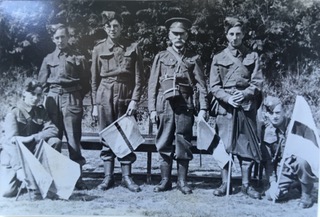 Signal Section No 2 Shaldon Platoon
Rear Left to Right: Hubert Bartlett, Ron Cload, Alfred Wood, and Stan Spear.
Front Left to Right: Brian Williams, and Dick Roberts.
Regiments stationed in Teignmouth
Fleet Air Arm
Royal Artillery Light Anti-Aircraft Batteries
The Queens Regiment (West Surrey)
The Buffs (Royal East Kent)
The Devonshire Regiment
The Black Watch (Royal Highlanders)
Oxford and Buckinghamshire Light Infantry
The Essex Regiment
Loyal North Lancashire Regiment
Durham Light Infantry
Tower Hamlets (The London Regiment)
Royal Air Force
Regiments stationed in Shaldon
Royal Artillery Coast Batteries
Royal Artillery Light Anti-Aircraft Batteries
9th Battalion The Buffs (Royal East Kent)
12th Battalion The Devonshire Regiment
2nd Battalion The Gloucestershire Regiment
The Black Watch (Royal Highlanders)
Oxford and Buckinghamshire Light Infantry
9th Battalion The Essex Regiment
Loyal North Lancashire Regiment
Durham Light Infantry
Royal Air Force
Contingents of Infantry Regiments were billeted at many houses in the village, some in the grounds of Undercliff Hotel, at the Manor House and many of the houses in Fore Street, in Bridge Road, and in the Victoria Hall. There were also Nissen huts at the top of Commons Lane. Towards the end of 1943 with the threat of invasion passing, many Regiments started to move out of Shaldon, Devon.

