The effect of war on Teignmouth docks and fishing
The outbreak of war in 1939 meant that Teignmouth docks could no longer trade with foreign countries in Europe, which affected principally its export of clay from the Kingsteignton quarries. In addition, the German navy gained control of the Channel ports so that the coastal trade from London and the Tyne in coal to Teignmouth was stopped. Convoys of ships were attacked, such as one convoy in Spring 1940 of 10 ships, 7 of which were sunk and 3 severely damaged by German E-boats and 300 planes.
Teignmouth’s trade was also affected by the threat of attacks both from the sea and the air. In the summer of 1940 the Harbour Commission was called upon to take immediate action to forestall an invasion. The Resident Naval Officer Captain Rees, who was based at the Royal Hotel on the Den, reported that “two craft were coming up from Dartmouth with buoys and wire for obstruction purposes and what with what we had in the shape of a piece of the Pier and other things they could manage”.
A few months later the Harbour Master reported that the wire barrage was satisfactory and was heaved clear of the channel when vessels were moving. Commercial shipping continued to come in and out of Teignmouth along the coast, although less than before the war. The Quay Company negotiated with government ministries to store stocks of coal, flour, sugar and timber in the dock areas.
Fishing on about nine fishing vessels continued during the early years of war, with the boom across the river mouth being raised for boats to go out to sea. The posts for the boom can still be seen on the beaches at either side of the river channel.
Before putting to sea, local fishermen reported to Captain Rees. They would be given a Recognition Signal using two letters of Morse Code, allowing them to re-enter the harbour after dark. The signals changed daily. Approaching fishing boats were challenged by a signal from a hand torch on the shore. The crew replied with the Recognition Signal and passed over the boom into the harbour at full throttle.
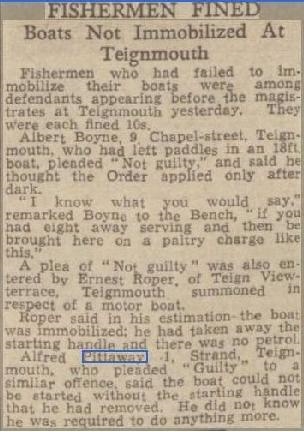
There were restrictions placed on the fishing boats: all boats in the harbour had to be immobilised when left unattended in the harbour so that they could not be used by the enemy. See the news clipping below about a court case against some local fisherman in August 1941. Six of the boats were requisitioned for military use in 1942 and 1943. There was a continued threat of submarines.
As the tide of the war began to turn in 1944, invasion barges and landing craft came into the harbour and the Admiralty agreed to pay the Harbour Commission £200 for its use. After the war, in 1946 the exports of clay and stone resumed along the coast and to Europe and there were small foreign imports of apples and slates.
With acknowledgement to H.J.Trump, West Country Harbour, Brunswick Press, Teignmouth , Devon, pub 1979.

