Marine John William Stephen Derges
Royal Marines PLY/X 2424
Date of Birth: September Quarter of 1920
Place of Birth: Honiton, Devon
Date of Death: Died 8th of June 1940 aged 19
Awarded the 1939-1945 Star and the War Medal 1939-1945


John William Stephen Derges was born in the 3rd quarter of 1920, at Honiton, Devon, and the son of William John and Emily Derges (née Gigg) of Teignmouth.
HMS Glorious
On the 6th of June 1940, HMS Glorious launched Swordfish aircraft for a bombing attack on German Head Quarters at Hundallan, Norway. The operation was aborted because of the weather and the aircraft returned to the aircraft carrier.
By the 8th of June, all the British and Allied troops had been embarked and the two convoys had set sail without being interfered with by the enemy. At this point, the carriers HMS Glorious, and HMS Ark Royal, had been operating north of Andenes Point, Lofoten Islands.
HMS Glorious had taken on board some 20 RAF Hurricane and Gladiator fighters, whose pilots had taken the unprecedented step of landing on an aircraft carrier to try and save their valuable aircraft. It also had on board 10 fighters (802 Squadron) and 5 torpedo bombers (823 Squadron) of the Fleet Air Arm.HMS Glorious - Navy Photos by Mark TeadhamBoth HMS Ark Royal and HMS Glorious were to have formed part of the escort to one of the convoys but in the early hours of the 8th of June, HMS Glorious made a signal to Vice Admiral Aircraft Carriers in HMS Ark Royal asking permission to proceed independently to Scarpa.
 HMS Glorious - Navy Photos by Mark Teadham
The request was approved and so HMS Glorious and her two escorting destroyers parted company with HMS Ark Royal at 02:53. Meanwhile, the German battlecruisers, Scharnhorst and Gneisenau (both of 32,000 tons, 9 x 11" and 12 x 5.9" guns), along with the heavy cruiser Hipper (of 14,000 tons) and four destroyers had sailed from Kiel on the 4th of June with orders to bombard the British base at Harstadt near Narvik.
On the 7th of June, news reached the German force that the British were attempting to withdraw and the commander of the group, Admiral Wilhelm Marschall decided to attack the southernmost of the two convoys.On the morning of the 8th of June, the German force encountered four British ships, the oil tanker, Oil Pioneer, the empty troopship Orama, the escort trawler, Juniper and the hospital ship, Atlantis. Only the hospital ship was spared.
This engagement however minor had cost the Germans time and fuel, and so the Hipper was ordered back to Trondheim to refuel with the destroyer escort while the two battle cruisers carried on the search. Shortly after 16:00, the two groups of ships sighted each other and action stations were sounded on HMS Glorious and attempts were made to get some of her aircraft ready for action.
The Scharnhorst and Gneisenau both increased speed to full and both opened fire at 16:32 and 16:46 respectively.HMS Glorious was hit by Scharnhorst's third salvo at 16:38, which penetrated the flight deck and exploded in the upper hanger starting a large fire that disrupted the attempts to get some aircraft airborne. Splinters damaged the boiler casing and smoke entered the air intakes, causing a temporary loss of steam pressure.
A second hit was received which killed most of the bridge crew.HMS Glorious with destroyer HMS Westminster - Navy Photos by Mark TeadhamThe escorting destroyers laid smoke to screen HMS Glorious, which was quite effective, forcing the Germans to cease firing, at about 17:00 until 17:20.
At this point any help from other British ships was out of the question as the cruiser HMS Devonshire was 100 miles away, the HMS Ark Royal and its group were 200 miles away and the cruisers HMS Southampton and HMS Coventry were 470 miles away.
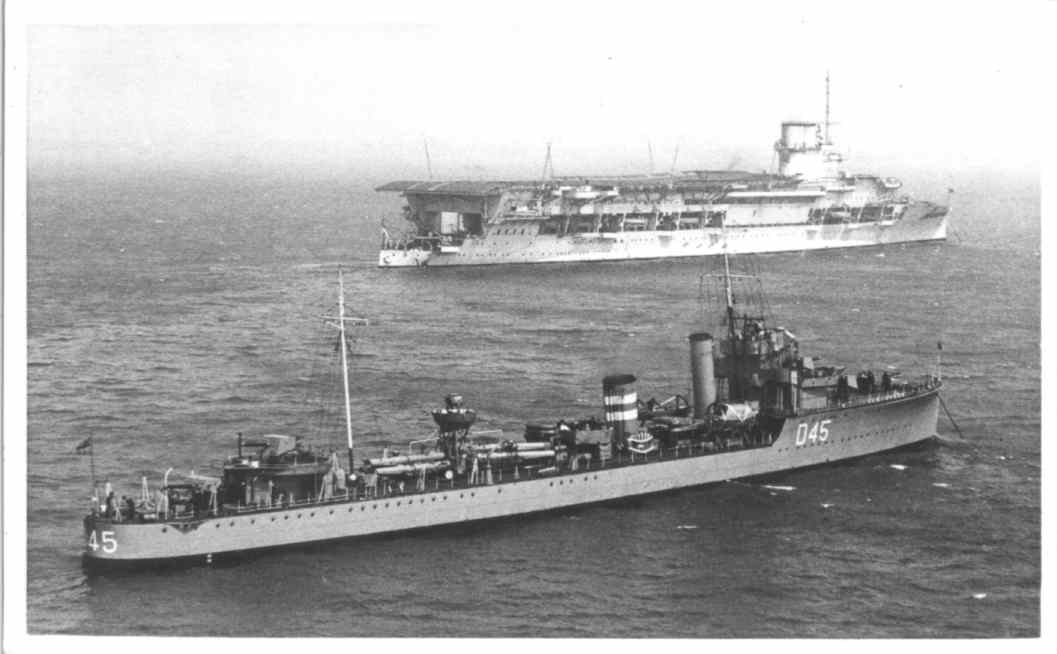 HMS Glorious with destroyer HMS Westminster - Navy Photos by Mark Teadham
HMS Devonshire picked up a barely intelligible signal at around 17:20 but did not break radio silence to pass it on. Onboard, was the King of Norway and his ministers and breaking radio silence would have involved serious risk in revealing her position. None of the other ships received HMS Glorious' radio signal, neither did any shore station.HMS Ardent managed to hit the Scharnhorst but received multiple hits from the 5.9" secondary armament and sank at around 17:25.
HMS Glorious received another hit in the centre engine room just after the Germans had recommenced firing that shook the whole ship, caused a loss of speed and a starboard list. Just after this, HMS Acasta passed ahead of Scharnhorst and maneuvered to onto its starboard side and fired two salvos of four torpedoes.
One hit Scharnhorst below the aft main battery turret that caused significant damage and casualties and forced the ship to sharply reduce speed. HMS Acasta also hit the Scharnhorst with her main guns but came under heavy and accurate fire and was badly damaged. She sank at about 18:20. By this time HMS Glorious had already sunk at around 18:10 and the German ships altered course for Trondheim. No attempt was made to pick up survivors.

